Lady Duncan’s return and unmasking of the false queen
The KillerLady Duncan’s return and unmasking of the false queen breaks open Macbett’s carefully staged authority: the woman he presents as his wife is revealed to be a sorceress who stole Lady Duncan’s appearance, while the rightful king’s widow emerges from imprisonment to denounce him as a murderer and usurper. The revelation does more than correct a false identity. It strips Macbett of the loyal partner he believes he possesses, exposes his guests’ participation in a fraudulent wedding, and announces that Macol has returned with an army against a country already turned against him.
The Missing Queen and the Return from Below
The disclosure begins with absence. A Maid reports that Lady Macbett has disappeared; when Macbett asks what she means, the Maid identifies his noble wife. Her room is empty, her possessions are gone, and her maid has vanished with them. The household has searched everywhere and called her name, but received only echoes. The details make the disappearance more than a momentary failure to find someone at the feast: the empty room and missing belongings indicate a departure that the people in the palace cannot explain or reverse.
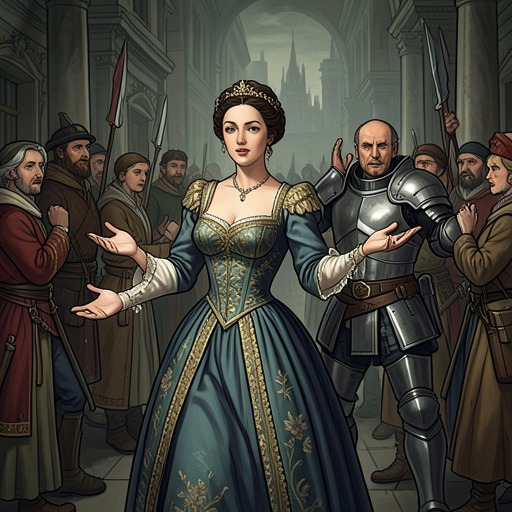
Macbett attempts to supply an ordinary explanation, telling the Maid that his wife had a headache and must have gone for a walk in the grounds to breathe fresh air before dinner. His explanation is immediately overtaken by the Maid’s announcement that Lady Macbett is coming. Lady Duncan enters from the cellar stairs, having just come up from below. The direction of her entrance makes the contrast visible: the woman who had been absent from the palace’s public life returns from its dungeon into the room where Macbett’s authority is on display. She no longer wears a crown, and her dress is rumpled. The stage image distinguishes her from the polished queenly appearance attached to her impersonator, even before she identifies herself.
The timing sharpens the reversal. The four Guests, who have been hurriedly taking swords from the wall and getting tangled as they buckle them on, stop when the Maid enters and turn toward her announcement. Their readiness for violence gives way to the sight of Lady Duncan. The scene therefore moves from a group preparing to act against an apparent threat to a public confrontation with the person whose imprisonment has helped conceal the truth. Her return changes what the room can know, and what Macbett can plausibly claim.
The Unmasking and the Disputed Wedding
Macbett tells Lady Duncan to take the place of honor, and a Guest hails her as the beloved sovereign. Lady Duncan answers by separating sovereignty from the identity Macbett has imposed on her: she asserts that she is sovereign, but not Lady Macbett. She names herself instead as the unhappy but faithful widow of her rightful king, the Archduke Duncan. The declaration restores the distinction that the wedding appeared to erase. Macbett may call her his wife, and the Guests may remember attending a wedding, but those public forms do not make the woman before them his lawful partner.
When Macbett insists that she is his wife and reminds her that the Guests were present at their wedding, Lady Duncan denies that the ceremony was her marriage. She explains that the figure they saw was a sorceress who had taken her face, voice, and body. The impostor threw Lady Duncan into the palace dungeons and chained her there. Now the chains have fallen and the bolts drawn back as if by magic. These details make the deception bodily as well as political: the false queen did not merely borrow a title or costume, but occupied the visible identity by which the real woman could have been recognized. Lady Duncan’s return exposes how thoroughly that substitution had distorted the wedding and the court’s understanding of who stood beside Macbett.
Her accusation is direct and personal. She refuses to be treated as Macbett’s accomplice and calls him the murderer of his master and friend, an usurper, and an impostor. Macbett asks how she knows what has been happening while imprisoned, turning the confrontation from a dispute over identity to a challenge about information. His question assumes that confinement should have kept her ignorant; her answer shows that the dungeon did not prevent her from learning what the court believed was hidden from her.
The Prison Telegraph and the Collapse of Denial
Lady Duncan says that her neighbors tapped messages through the wall in code on a prison telegraph. Through them, she learned everything there was to know. The means of communication is small and improvised, but its dramatic consequence is large: the dungeon’s walls have failed to isolate her from the events above. Information has passed between prisoners through knocks and code, while Macbett’s court has mistaken physical confinement for control over knowledge. The revelation also answers the Guests’ incredulity without requiring Lady Duncan to have witnessed events outside the prison herself.
She tells Macbett to look for his beautiful wife, whom she calls an old hag, and taunts him with the possibility that the sorceress has disappeared. Macbett’s sung lament distinguishes this encounter from the appearance of a ghost: this time, the woman confronting him is not an apparition. He then dwells on the impostor’s beauty, saying that she had made Lady Duncan’s appearance, movements, and voice even more beautiful, and wonders where she has gone. His attention to the vanished sorceress contrasts with Lady Duncan’s insistence on the crimes and political danger before him. The Guests’ song, shifting between declarations for and against Macbett and Lady Duncan, makes allegiance sound unstable rather than settled.
Lady Duncan states that the witch will no longer help him and has abandoned him. Macbett rejects the warning, insisting that being king means he needs no one’s help, and orders the Guests out as slaves. His answer momentarily asserts power, but the scene has already shown how much his position depends on claims that can be challenged: a marriage whose apparent bride was an impostor, a queen whose absence he tried to explain away, and a court whose members are already armed and singing contradictory loyalties.
Macol’s Return and the Threat to Macbett’s Rule
Before disappearing, Lady Duncan gives the confrontation a concrete political consequence. Macol, Duncan’s son, has returned from Carthage and mustered a large and powerful army. She says the whole country is against Macbett and that he has run out of friends. The warning transforms the unmasking from a revelation about the past into an announcement of the approaching contest for rule. Lady Duncan has not simply escaped the dungeon: she returns able to identify both the falsehood sustaining Macbett’s marriage and the force gathering against his kingship.
The scene closes by making the threatened change public. Shouts call for Macol and against Macbett, followed by fanfares as Macol enters. In that sequence, Lady Duncan’s warning is confirmed by the stage action immediately after she disappears. Macbett’s guests have already shown their readiness to arm themselves and their divided allegiance; the crowd’s cries now give the opposition a name and a returning claimant. The event thus turns on successive reversals: disappearance becomes return, the supposed wife becomes an impostor, the prisoner becomes the informed accuser, and the king who claims not to need help is confronted with an army and a country against him.